
Landscape Rock Calculator
Enter the length and width of your bed, choose a depth and a rock type, and get the volume in cubic feet and cubic yards, an estimated weight in tons, and how many bags you would need if you buy bagged stone.
- Free to use
- No sign-up
- Runs in your browser
Quick answer
A cubic yard of most landscape rock weighs about 1.3–1.5 tons, or 2,600–3,000 lb. River rock is often estimated at 1.35 tons per cubic yard, while pea gravel and crushed stone are often about 1.4 tons. Lava rock is much lighter, about 0.6 tons per cubic yard. To estimate tons, multiply cubic yards by the rock density.
Calculate landscape rock
Landscape Rock Estimate Workbook
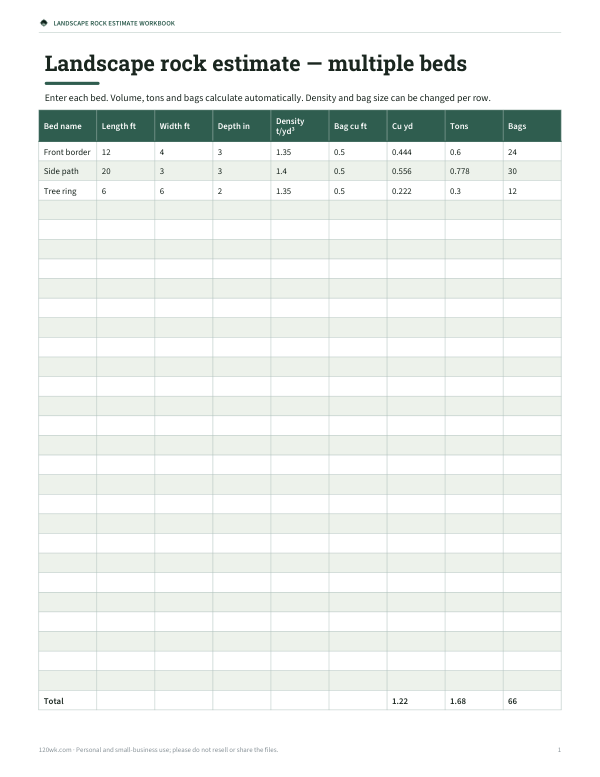
Estimate several beds at once, compare bulk versus bagged cost and print a delivery checklist.
- Multi-bed estimate workbook (XLSX)
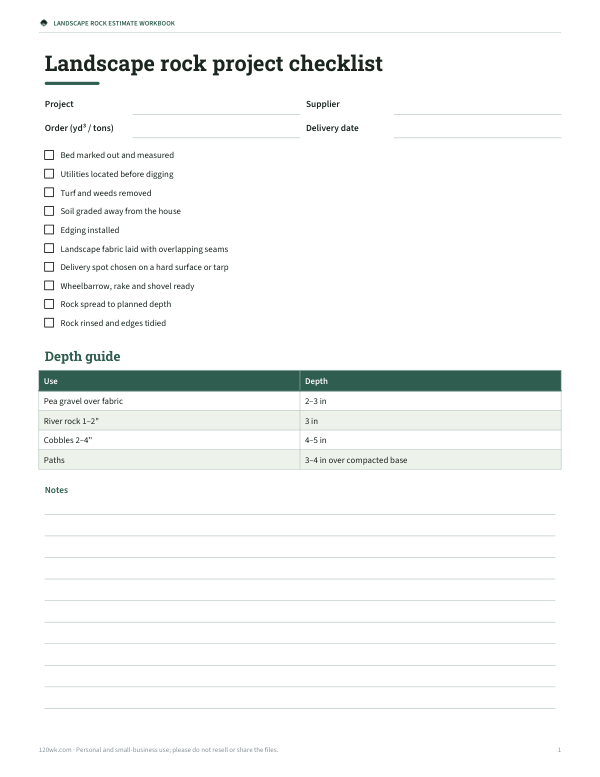
- Project & delivery checklist (PDF, DOCX)
Formats: XLSX, PDF, DOCX. Instant download after payment (link valid 72 hours, up to 5 downloads). AI-assisted: the templates were drafted with AI help and reviewed and laid out before publishing.
$5.00 USD, one-time
- Instant download
- 7-day refund
- Secure checkout by Stripe
7-day money-back guarantee. Full refund within 7 days of purchase, even after you download.
Full refund within 7 days — see the refund policy and license.
Free printables
Single sheets you can print right now, no sign-up. The full pack adds every sheet in one download plus the editable files.
Typical weight of landscape rock
Use these typical calculator densities to convert cubic yards to tons or estimate coverage.
| Rock type | Tons/yd³ | lb/yd³ | yd³ per ton | 1 ton covers at 3 in |
|---|---|---|---|---|
| River rock 1–3 in | 1.35 | 2,700 | 0.74 | 80 sq ft |
| Pea gravel | 1.4 | 2,800 | 0.71 | 77 sq ft |
| Crushed stone / gravel | 1.4 | 2,800 | 0.71 | 77 sq ft |
| Decomposed granite | 1.4 | 2,800 | 0.71 | 77 sq ft |
| Mexican beach pebbles | 1.35 | 2,700 | 0.74 | 80 sq ft |
| Lava rock | 0.6 | 1,200 | 1.67 | 180 sq ft |
| Marble chips | 1.3 | 2,600 | 0.77 | 83 sq ft |
How the landscape rock calculator works
Landscape rock is sold by volume (cubic yards, or cubic feet for bags) or by weight (tons). The calculator first finds the area of your bed, multiplies it by the depth to get volume, and then converts volume into weight using a typical bulk density for the stone you choose.
- Area: length × width for a rectangle; π × (diameter ÷ 2)² for a circle; base × height ÷ 2 for a triangle.
- Volume in cubic feet = area in square feet × depth in inches ÷ 12.
- Cubic yards = cubic feet ÷ 27 (a cubic yard is 3 ft × 3 ft × 3 ft).
- Tons = cubic yards × density in tons per cubic yard.
- Bags = cubic feet ÷ bag size, rounded up to whole bags.
The optional extra percentage covers stone that settles into the soil or fabric, spills during spreading and uneven ground. Five percent is a reasonable default for a level bed; use ten percent for irregular shapes or a bed you will edge by eye.
How deep should landscape rock be?
Depth is the number that changes your order the most, so choose it for the job the rock has to do. As a rule, the layer should be at least twice as deep as the largest stones so the base is fully covered.
| Use | Typical rock | Suggested depth |
|---|---|---|
| Decorative cover over landscape fabric | Pea gravel, 3/8"–3/4" crushed stone | 2–3 in |
| Shrub beds and borders | River rock 1"–2" | 3 in |
| Larger river rock or cobbles | 2"–4" stone | 4–5 in |
| Dry creek bed | Mixed 1"–6" rock | 4–6 in plus boulders |
| Walkways and paths | Pea gravel or decomposed granite | 3–4 in over a compacted base |
| Lava rock around plants | Lava rock 3/4"–1.5" | 2–3 in |
Deeper is not always better. Very thick gravel around plant stems holds heat and can make it hard to water; a thinner layer over good fabric usually looks cleaner and costs less.
Worked example
A bed 12 feet long and 4 feet wide has an area of 48 square feet. At a depth of 3 inches the volume is 48 × 3 ÷ 12 = 12 cubic feet, which is 12 ÷ 27 = 0.44 cubic yards. With river rock at about 1.35 tons per cubic yard, that is roughly 0.6 tons, or about 1,200 pounds. Adding 5% for settling gives 12.6 cubic feet — 26 bags of 0.5 cubic feet each. For a bed this size bagged stone is practical; for anything above about one cubic yard, bulk delivery is usually cheaper per ton.
Cubic yards, tons or bags: which should you order?
Landscape suppliers usually sell bulk stone by the cubic yard or by the ton, while garden centres sell bags of 0.5 or 0.75 cubic feet, sometimes marked by weight such as 40 or 50 pounds. One cubic yard is 27 cubic feet, so it equals 54 bags of 0.5 cubic feet. Bulk orders often have a minimum delivery and a delivery fee, so bags can be cheaper for small beds even though the stone costs more per yard.
- 1 cubic yard covers about 324 sq ft at 1 in deep, 162 sq ft at 2 in, 108 sq ft at 3 in and 81 sq ft at 4 in.
- A ton of typical gravel is roughly 0.7–0.75 cubic yards.
- A standard pickup bed holds roughly 1–2 cubic yards of rock by volume, but weight is the real limit — check your truck's payload before hauling stone yourself.
Rock density and why it matters
Density is the weight of a cubic yard of loose stone. Most dense landscape stones such as river rock, pea gravel, crushed granite and limestone fall between about 1.3 and 1.5 tons per cubic yard. Lava rock is porous and much lighter, often around half a ton per cubic yard, which is why a ton of lava rock covers far more ground. Wet stone weighs more than dry stone, and suppliers quote different figures for the same product, so if you order by weight, ask the yard for the density they use and type it into the custom field.
Preparing the area before the rock goes down
- Remove turf and weeds, and grade the soil so water drains away from buildings.
- Install edging — steel, aluminium, plastic or stone — to stop rock migrating into lawn.
- Lay a woven landscape fabric under decorative gravel to reduce weeds and keep stone from sinking; overlap seams by several inches.
- For paths, compact a base of crushed stone before the top layer so the surface stays firm.
- Spread rock with a rake held tines-up for the final level, then water lightly to wash off dust.
Frequently asked questions
How many tons of rock do I need?
Multiply square feet by depth in inches, divide by 324 to get cubic yards, then multiply by the rock’s tons per cubic yard. For example, 200 sq ft at 3 in is 1.85 yd³; at 1.35 t/yd³, order about 2.5 tons before extra.
How much does a yard of rock weigh in pounds?
A cubic yard of most dense landscape rock weighs about 2,600 to 3,000 lb. The calculator uses 2,700 lb/yd³ for river rock, 2,800 for pea gravel or crushed stone, and 1,200 for lava rock.
How much does a ton of rock weigh?
In the U.S., a ton means a short ton: exactly 2,000 lb, or about 907 kg. The variable part is not the ton; it is how many cubic yards that ton fills, which depends on rock density.
How many square feet does a ton of landscape rock cover?
At 1.35 tons per cubic yard, one ton is about 0.74 cubic yards, which covers roughly 80 sq ft at 3 in deep or 120 sq ft at 2 in deep.
How much does a cubic yard of river rock weigh?
Typically about 1.3–1.4 tons (2,600–2,800 lb) dry. Exact weight depends on the stone and moisture.
How many bags of rock are in a cubic yard?
54 bags of 0.5 cubic feet, 36 bags of 0.75 cubic feet, or 27 bags of 1 cubic foot.
Should I put landscape fabric under rock?
Usually yes for decorative gravel beds: it reduces weeds and keeps stone from mixing into soil. Around plants that need regular feeding, some gardeners prefer no fabric.
Is the weight exact?
No. It is an estimate from typical densities. Use it to plan loads and budget, and confirm the supplier's figure when ordering by the ton.